
Joaquim Magalhães de Castro
An earthquake can cause many things to collapse in a matter of seconds. Homes, places of worship, schools – even our sense of security can suddenly become fragile. However, amidst the devastation caused by the earthquake that struck the Indonesian island of Flores on August 15, we witnessed the emergence of a remarkable spirit of solidarity: people began to help each other generously and without reservation. Many began sending food, distributing medicine, and offering their time as volunteers. Government agencies, health professionals, humanitarian organizations, and local Catholic communities mobilized through their respective networks.
The Diocese of Ruteng is among the hardest hit by the earthquake and suffered extensive damage. Caritas’ operational centers are active throughout the island, coordinating humanitarian assistance in the four dioceses: the Archdiocese of Ende and the Dioceses of Maumere, Ruteng, and Labuan Bajo. The official death toll in Flores has reached 100, including 48 women and children. More than 1,600 people were injured, many with serious trauma caused by collapsing structures. The number of internally displaced persons—those who were forced to leave their homes—has exceeded 180,000. They are living in makeshift camps, stadiums, and public squares. The tremors damaged approximately 74,000 homes, of which 23,000 collapsed completely or became uninhabitable. Infrastructure was also severely affected: more than 319 schools and 124 health centers are out of service. The seismic swarm, which has already recorded more than 2,000 aftershocks, continues to fuel fear among the population, while humanitarian agencies report shortages of essential supplies, including drinking water, adequate sanitation facilities, blankets, and waterproof tarpaulins for shelter. Particularly worrying is the situation of isolated communities in the mountains, as landslides and road blockages have severely hampered the work of rescue and civil protection teams. Several indigenous communities in the mountainous areas of the Manggarai, East Manggarai, and Sikka districts have not yet received ongoing assistance and remain without electricity, basic services, and humanitarian aid.
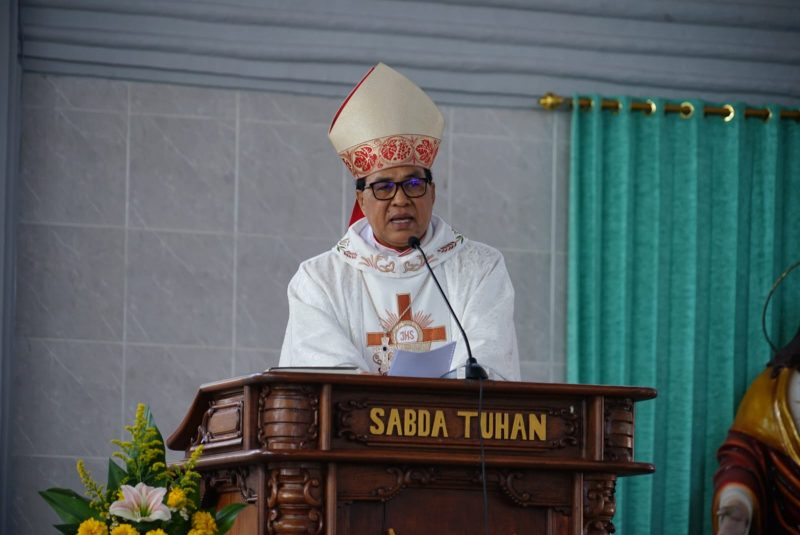
Bishop Sipriano Hormat of Ruteng says the following about the catastrophe: “We normally think of resilience in terms of earthquake-resistant buildings, roads, electricity, and hospitals. However, communities also possess an infrastructure that is not made of concrete: trust, habits of mutual aid, and the ability to connect needs with resources. This strength is known as ‘social capital.’ Its meaning is simple: men and women ensure that their neighbors have food; people lend their vehicles, and volunteers reach hard-to-access locations.
The Indonesian Bishop emphasizes that “good intentions alone are not enough: kindness also requires organization. Aid must reach those who need it, needs must be clearly identified, and resources must be directed to those who are vulnerable.”
In this context, Sipriano Hormat became personally involved, traveling tirelessly throughout the diocese to visit makeshift camps, remote communities, and hospitals. “This experience,” he says, “reshaped my understanding of episcopal ministry.” A bishop, as the head of a community, needs to make decisions and connect needs to resources. He is not a lone hero, and there is something he cannot delegate: presence. I went to meet people affected by the earthquake. There are times when presence cannot be replaced by a phone call; times when people who are suffering don’t need a speech, but simply a pastor willing to be present.” “After several visits, I received messages from people expressing their gratitude for my presence. I hadn’t done anything extraordinary. I was simply there, to offer a word of comfort and consolation, to say and show that God does not abandon us. We live in a time when presence can easily be replaced by a message of empathy. However, human suffering cannot be fully understood through a screen. Presence is not primarily about being seen by those who suffer, but about being willing to see those who suffer.” Ultimately, everything must be understood in the light of faith. “We place our trust in God.”
“The mystery of suffering,” he observes, “is simply too profound to be reduced to easy explanations. I have no answer for it.”
Why does one person survive while another does not emerge from the rubble? The question I carry with me is: “What is the purpose of this life that has been given to me?” Being present is a responsibility. And this responsibility concerns everyone: each of us has something to offer—our skills, our time, our authority, or simply two hands ready to work and unite in prayer. All of this acquires social meaning when it becomes a means of sustaining the lives of others.” As the social doctrine of the Church reminds us, solidarity is not a vague feeling of compassion, but a firm and persevering commitment to the common good, because we are all responsible for one another,” he recalls. He adds: “When I was ordained a bishop, I chose the motto Omnia in Caritate: to do everything in charity. I found this spirit even beyond the limits of the Church: among volunteers, healthcare professionals, government officials, and members of the armed forces.” Looking to the future, the bishop concludes: “After the emergency, the recovery period will last much longer than the time a disaster remains in the media spotlight.” Homes need to be rebuilt, traumas need to be treated and healed, and livelihoods restored. This is where social capital faces its next test: the network of solidarity cannot rely solely on spontaneity; it needs to be underpinned by good governance. Flores needs more resilient homes, safer schools, and better disaster management. And you need people who cannot bear to see others suffer alone.