
Joaquim Magalhães de Castro
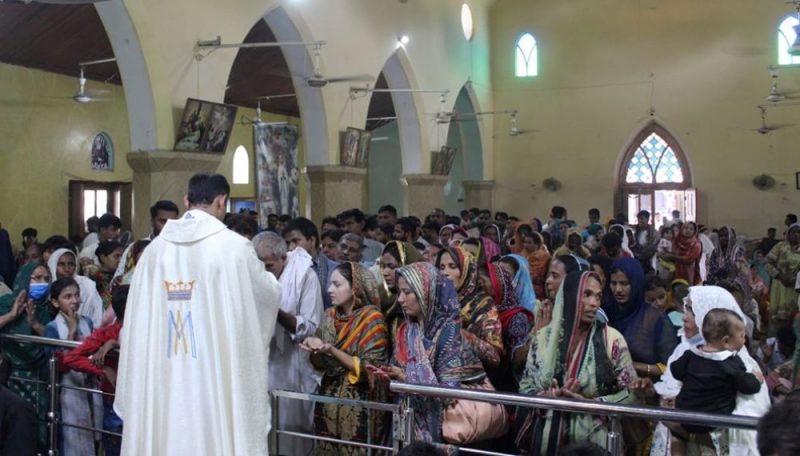
The rain, the disruptions, and the forecasts of bad weather did not diminish the deep Marian devotion of the faithful in Pakistan. On September 4th, celebrations began at the Mariamabad Shrine for the 77th National Pilgrimage, a pillar of Marian devotion among Pakistani Catholics, which ended on September 6th. “It was deeply moving. Despite the forecasts of severe weather, with heavy rains that could cause flooding and make it extremely difficult for the faithful to remain in the open area in front of the Shrine, where pilgrims set up their camps, they remained firm in their faith and in their deep bond with the Virgin Mary: nothing can separate them from the love of Christ,” Father Qaisar Feroz OFM Cap, parish priest in Lahore and spokesperson for the Catholic Episcopal Conference of Pakistan, told Fides News Agency. He was present in Mariamabad with his community. Thousands of people from all the dioceses of Pakistan traveled in pilgrim caravans: on foot, by bicycle, by motorcycle, by truck, and by bus. It was an impressive mobilization of faith throughout the country: families traveled thousands of kilometers to pray to Mary, place themselves under her mantle, entrust their lives and difficulties to her, and implore graces from their heavenly Mother. The pilgrims (nearly 500,000) participated in the opening Mass celebrated by the Archbishop of Lahore, Khalid Rehmat. Among them were also Muslims and Hindus. “Mary attracts the heart of everyone,” Father Feroz observes. This year’s pilgrimage also had a distinctly “Franciscan” character, marking the 800th anniversary of the death of St. Francis of Assisi. The Franciscans in Pakistan led the Meditated Rosary in Mariamabad, using texts and passages from the Franciscan Sources that reflect St. Francis of Assisi’s profound love for the Virgin Mary. “The Rosary was an immense prayer for peace, which was joined by thousands of pilgrims,” says Father Feroz.
Mariamabad, also known as the “City of Mary,” is the most important national Marian shrine in Pakistan. Located in the province of Punjab, about 80 kilometers from Lahore, its history is linked to the work of Belgian Capuchin missionaries and, in particular, to the figure of Father Felix van de Putte, its founder. At the end of the 19th century, Capuchin missionaries in Pakistan realized that the new converts to Christianity, most of them ethnic Punjabis belonging to the poorest strata of society, were subject to severe discrimination, oppression, and conditions of semi-slavery at the hands of local landowners.
To free these families from poverty, the Capuchin bishop Emmanuel Van Den Bosch bought about 150 acres of arid and underdeveloped land in the Sheikhupura district from the British government, with the aim of establishing a village for Christians.
In January 1893, three Christian families, accompanied by missionaries, undertook a six-day journey to reach the new land and founded an agricultural village, which they named Maryabad (later Mariamabad), meaning “City of Mary.”
Father Felix arrived in Mariamabad in 1896 and became its true pillar and builder. He expanded the colony and promoted the agricultural, social, and spiritual development of the community. He organized farming systems so that Catholic families could finally work their own land, build permanent homes, and live from their work with dignity and security. Father Felix also directed the construction of the new church, which was consecrated on December 8, 1898. Since then, the faithful have developed a deep devotion to the Virgin Mary, praying the Rosary every day. In the following years, the Capuchin friars built a grotto similar to that of Lourdes in France, placing a statue of Our Lady on top of a small hill near the church.
In 1949, Mariamabad was officially declared the National Marian Shrine of Pakistan. The site has also become a rare and extraordinary place for interreligious dialogue, regularly visited not only by Christians but also by a large number of Muslims and Hindus, who come to honor Mary and seek her intercession. In Islam, Mary (called Maryam) is honored as the mother of the prophet Jesus (Isa) and is the only woman to have an entire chapter named after her in the Quran. This shared reverence transforms local Marian shrines into unique spaces of peaceful coexistence. The presence of Mary is deeply rooted in the daily lives of local Catholic communities. Virtually every Catholic parish in Pakistan has a small Marian grotto at its entrance. It is common to see the faithful lighting candles, burning incense, and placing flowers at the feet of the image. The prayer of the rosary is intensely cultivated within homes. In times of political instability or connflicts in the region, communities unite in prayer chains through the Rosary to ask for Mary’s intercession for national peace. The central point of prayer is a replica of the Lourdes grotto (France), built in 1927, which boasts a 3.5-meter-high statue of the Virgin Mary. Recently, the Archdiocese of Lahore began construction of a new Marian space to accommodate the growing crowd of faithful.
The Virgin Mary is popularly seen as a protective mother to whom one turns in times of serious illness, despair, or infertility. The shared respect for Mary helps break down rigid social barriers. It is common to see Muslim women in burkas visiting Catholic holy sites to make promises or give thanks for graces received.