
- Marco Carvalho
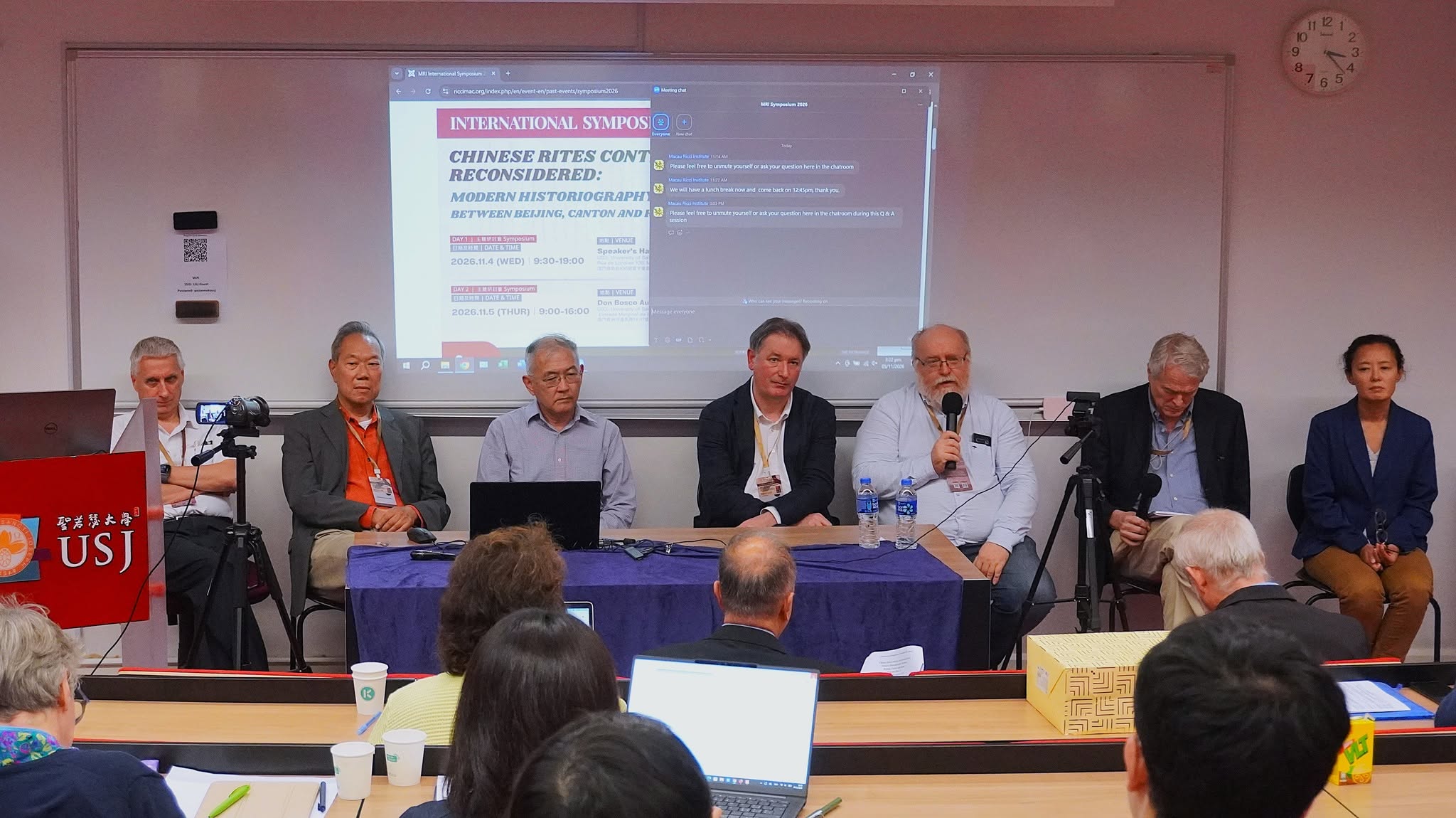
Leading international historians and theologians gathered at the University of Saint Joseph (USJ) earlier this month for the 2026 International Symposium of the Macau Ricci Institute. The two-day conference re-examined the historic relevance of the Chinese Rites Controversy through newly published and rediscovered Jesuit archives.
Held across USJ’s Ilha Verde and Saint Joseph Seminary campuses on the 4th and 5th of November, the symposium, titled “The Chinese Rites Controversy Reconsidered: Modern Historiography between Beijing, Canton, and Rome,” drew scholars from places such as France, the United States, Italy, Poland and mainland China. The event was co-organized by the Macau Ricci Institute, the Ricci Institute for Chinese-Western Cultural History at Boston College and the Jesuit University Ignatianum in Krakow.
For the first time in its history, the symposium also received the official patronage of a Vatican-affiliated institution. According to Father Jaroslaw Duraj, S.J., Director of the Macau Ricci Institute, the Pontifical Committee for Historical Sciences formally endorsed the event after reviewing its academic program. "They saw our program and expressed great satisfaction with the work we are doing," Duraj noted, describing the endorsement as a major milestone for the Ricci Institute. “The Pontifical Committee for Historical Sciences formally agreed to be the patron of the Symposium. Paradoxically, this patronage shows that, unlike in the past, when Macau and Canton were rather looked at with suspicion by the Vatican due to the Rites Controversy, now there is a reverse trend. I am sure that the Vatican, the dignitaries and the specialists there, they understand more of this role of Macau, not only in an historical perspective, but a contemporary one also. We need to underline that very important role in the past, but I am glad to see that the Vatican, by promoting several events and by sending Cardinal Tagle to the Diocesan Jubilee celebrations, seems to be appreciating more and more the historical primacy of Macau”, the Polish Jesuit adds.
A central focus of the symposium was the completion of a 26-year colossal academic endeavor: the annotated English translation of the fourth and final volume of “Acta Pekinensia”, which hit bookshelves on the same day the conference began. Written in Beijing between 1705 and 1712 by German Jesuit Kilian Stumpf, S.J., the 1,400-page eyewitness chronicle documents the theological and intercultural clash over whether Confucian rites and ancestor veneration was compatible with Catholic doctrine. Published in full by Brill in collaboration with Boston’s Ricci Institute, the complete four-volume set provides scholars with an unprecedented firsthand account from inside the Qing imperial court: “We don’t really need to underline the importance of “Acta Pekinensia”. This is a firsthand account, a personal testimony of someone which was at the Chinese court, which was observing everything, was witnessing everything. The primary importance of this source is truly without a doubt. Hopefully, we hope that these four volumes and the whole series will be an opportunity for scholars to go deeper. So far, researchers did not have the opportunity to study this firsthand account using the whole collection. The four volumes include more comments and important elements”, Father Duraj says, emphasizing that having the full collection finally available opens critical new avenues for academic research.
Scholars presenting their works at the symposium noted that Stumpf’s records reveal how the 16th-to-18th-century dispute extended far beyond theology, deeply involving court diplomacy, the interpretation of ancient Chinese history, and classical texts.
Alongside the Beijing perspective, the second day of the symposium examined the controversy from Rome through the newly rediscovered Latin manuscripts of Polish Jesuit Tomasz Ignacy Dunin Szpot, S.J. Although Szpot never traveled to Asia, he compiled vast histories of the China mission—including Historiae Sinarum Imperii, Collectanea pro Historia Sinica, and Collectanea Historiae Sinensis—using letters and documents sent to the Jesuit Curia and the Vatican. A team of researchers from the Jesuit University Ignatianum in Krakow is currently translating Szpot’s works from Latin after they were recently uncovered in the Curia archives: “This group of historians has started to work on a very important project which was, until recently, completely unknown to scholars and scholarship, namely the “Historiae Sinarum Imperii”. This is one of several Latin texts authored by Tomasz Dunin Szpot, a Polish Jesuit who resided in Rome around the time of the Rites Controversy. He was collecting a lot of information and working on different sources: letters and documents that were sent to Rome, both to the Vatican and the Jesuit Curia. He managed to compile and present them in such a way that it was comprehensive not only to the authorities in Rome, but mainly to the public”, the director of the Macau Ricci Institute asserts. “He coined ten volumes of a text that was, I would say, rediscovered not long ago in the archives of the Curia. Now, this group of scholars is working on it, translating it from Latin and, hopefully, in the coming future that translations will be also published by Brill”, Father Jaroslaw Duraj told "O Clarim”.
Conference presentations hailing from Tomasz Dunin Szpot’s writings explored the Canton Exile and the friction between sacred and secular authority under the Shunzhi and Kangxi emperors. Additional sessions incorporated non-Jesuit and broader European historiographical sources to provide a more comprehensive picture of early modern Sino-Western cultural dynamics and the East-West divide brought by the Chinese Rites Controversy.